> ## Documentation Index
> Fetch the complete documentation index at: https://basedash.com/docs/llms.txt
> Use this file to discover all available pages before exploring further.
# Slack app
> Your AI data analyst in Slack — ask questions, get charts back, and receive automations and insights in your channels
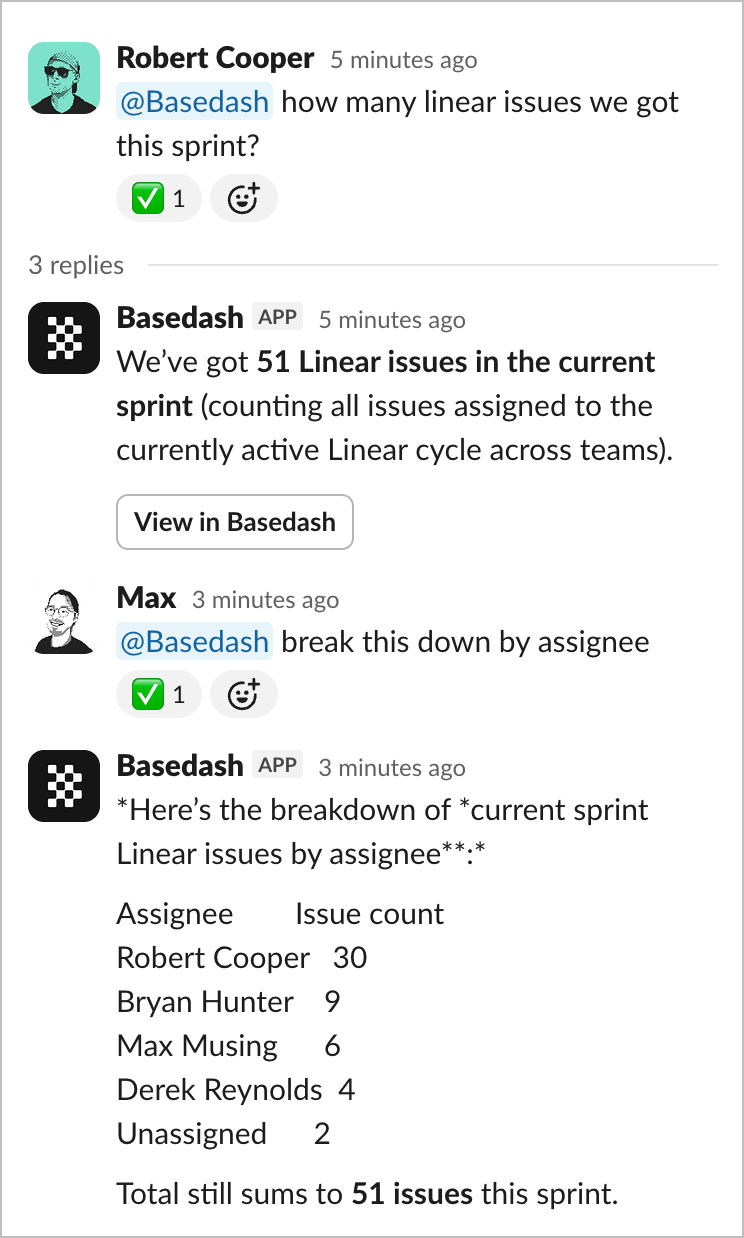 Basedash for Slack brings your AI data analyst directly into your team's workflow. Ask questions about your data by mentioning `@Basedash`, get answers back with charts embedded as images, share charts to channels, and receive automation and insight notifications without leaving Slack.
The Basedash app is available in the official [Slack Marketplace](https://slack.com/marketplace).
## Getting started
There are two ways to install the Basedash app for Slack:
* **From the Slack Marketplace**: Find Basedash in the [Slack Marketplace](https://slack.com/marketplace) and select "Add to Slack".
* **From Basedash**: Open the command menu (⌘K -> Settings) and select "Install Slack app". A popup will open to request permissions.
Once the bot is authorized, you should receive a welcome message from the app in Slack and be able to message the Basedash app.
## Ask questions with @Basedash
Basedash for Slack brings your AI data analyst directly into your team's workflow. Ask questions about your data by mentioning `@Basedash`, get answers back with charts embedded as images, share charts to channels, and receive automation and insight notifications without leaving Slack.
The Basedash app is available in the official [Slack Marketplace](https://slack.com/marketplace).
## Getting started
There are two ways to install the Basedash app for Slack:
* **From the Slack Marketplace**: Find Basedash in the [Slack Marketplace](https://slack.com/marketplace) and select "Add to Slack".
* **From Basedash**: Open the command menu (⌘K -> Settings) and select "Install Slack app". A popup will open to request permissions.
Once the bot is authorized, you should receive a welcome message from the app in Slack and be able to message the Basedash app.
## Ask questions with @Basedash
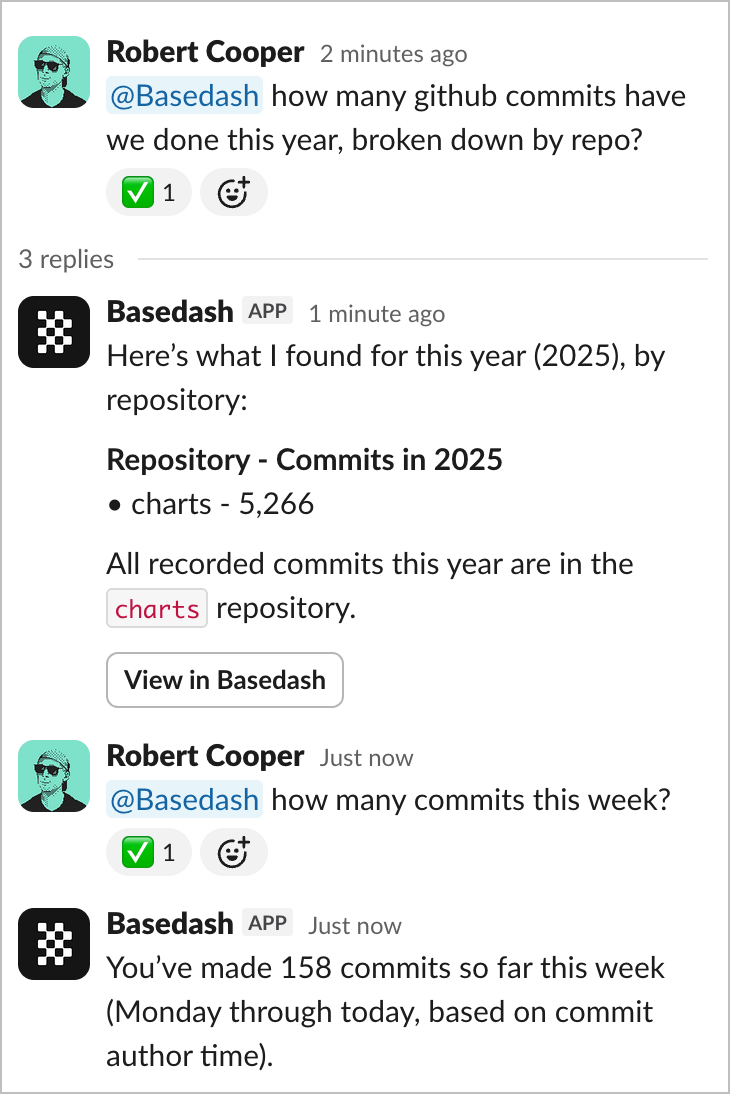 Mention `@Basedash` in any channel or direct message to ask questions about your data in natural language. The AI will query your connected databases and respond with the answer directly in Slack. While it works, Slack shows the app's native thinking status, so you can see that Basedash is on it from the moment you send the message.
If your organization uses [row-level
security](/features/row-level-security#rls-with-slack-integration), it applies
to all Slack queries based on the user's Basedash account.
### Example questions
* "@Basedash how many users signed up this week?"
* "@Basedash show me our top 10 customers by revenue"
* "@Basedash what's our conversion rate for the last month?"
* "@Basedash compare sales this quarter vs last quarter"
AI-generated responses may be inaccurate. Always verify important data before
making decisions based on Basedash chat responses.
### Charts in replies
When a visualization helps answer your question, Basedash replies with a chart embedded directly in the thread as an image — ask a trend question and you get the trend, not just a sentence about it. Each chart includes a link back to Basedash so you can open the live version, iterate on it, or add it to a dashboard.
### Thread conversations
Ask follow-up questions in a thread to refine your results or dig deeper into the data. Basedash maintains context throughout the thread, so you can have a natural conversation about your metrics without repeating yourself.
For example:
* Start with: "@Basedash show me monthly revenue for this year"
* Follow up with: "@Basedash break that down by region"
* Then: "@Basedash which region has the highest growth rate?"
### Two-way message sync
Mention `@Basedash` in any channel or direct message to ask questions about your data in natural language. The AI will query your connected databases and respond with the answer directly in Slack. While it works, Slack shows the app's native thinking status, so you can see that Basedash is on it from the moment you send the message.
If your organization uses [row-level
security](/features/row-level-security#rls-with-slack-integration), it applies
to all Slack queries based on the user's Basedash account.
### Example questions
* "@Basedash how many users signed up this week?"
* "@Basedash show me our top 10 customers by revenue"
* "@Basedash what's our conversion rate for the last month?"
* "@Basedash compare sales this quarter vs last quarter"
AI-generated responses may be inaccurate. Always verify important data before
making decisions based on Basedash chat responses.
### Charts in replies
When a visualization helps answer your question, Basedash replies with a chart embedded directly in the thread as an image — ask a trend question and you get the trend, not just a sentence about it. Each chart includes a link back to Basedash so you can open the live version, iterate on it, or add it to a dashboard.
### Thread conversations
Ask follow-up questions in a thread to refine your results or dig deeper into the data. Basedash maintains context throughout the thread, so you can have a natural conversation about your metrics without repeating yourself.
For example:
* Start with: "@Basedash show me monthly revenue for this year"
* Follow up with: "@Basedash break that down by region"
* Then: "@Basedash which region has the highest growth rate?"
### Two-way message sync
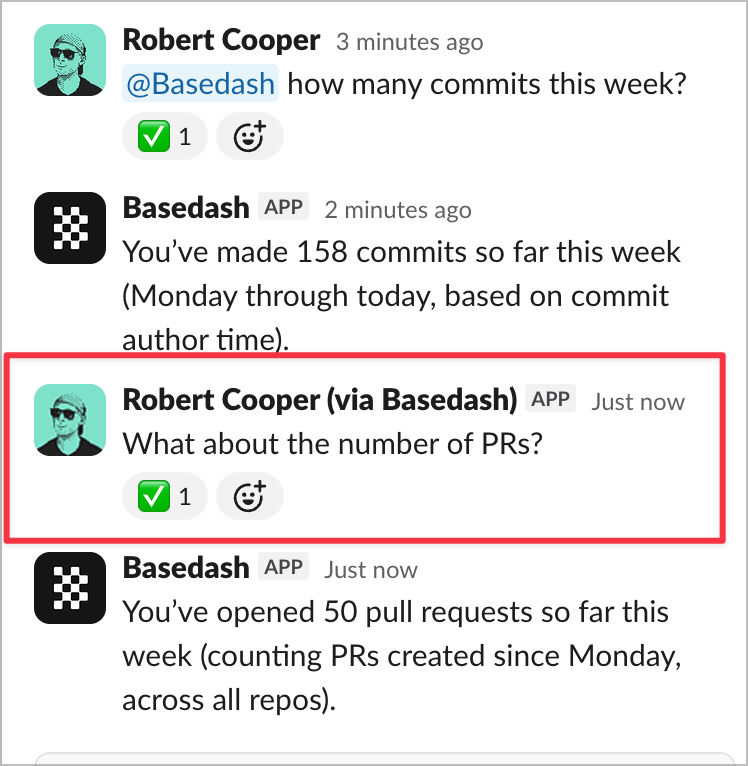 Chats started in Slack are synced to Basedash. If you start a conversation in Slack, you can continue it in Basedash—and any responses will appear back in the Slack thread. This makes it easy to switch between platforms without losing context.
### Image support
You can attach images to your messages when asking questions. This is useful for sharing screenshots of charts or data that you want Basedash to analyze or reference.
### User matching
Basedash automatically matches Slack users to their Basedash accounts using email addresses. This enables features like row-level security to work correctly, ensuring users only see data they have permission to access—even when asking questions in Slack.
## Share charts to Slack
Chats started in Slack are synced to Basedash. If you start a conversation in Slack, you can continue it in Basedash—and any responses will appear back in the Slack thread. This makes it easy to switch between platforms without losing context.
### Image support
You can attach images to your messages when asking questions. This is useful for sharing screenshots of charts or data that you want Basedash to analyze or reference.
### User matching
Basedash automatically matches Slack users to their Basedash accounts using email addresses. This enables features like row-level security to work correctly, ensuring users only see data they have permission to access—even when asking questions in Slack.
## Share charts to Slack
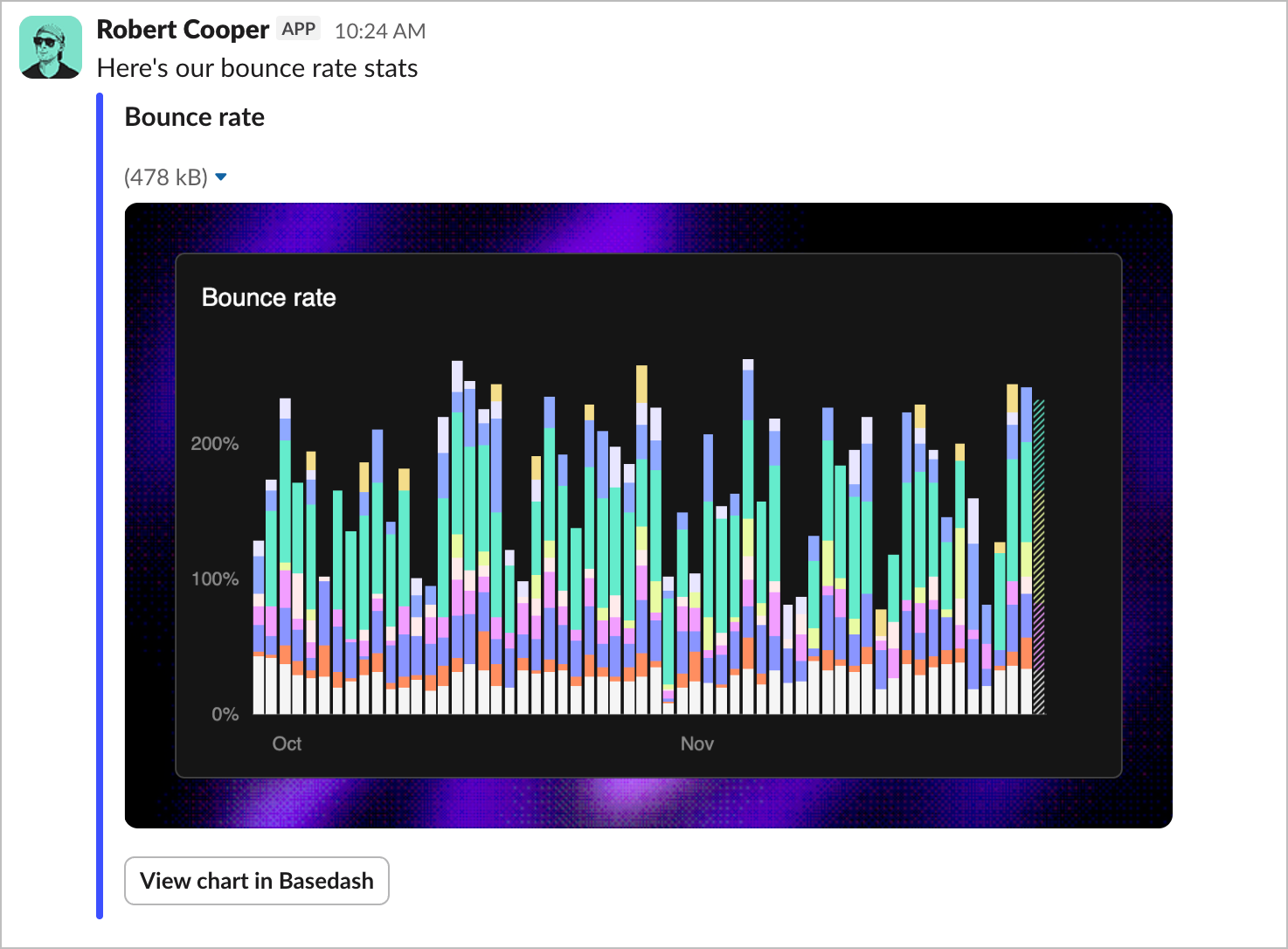 Share any chart from Basedash directly to a Slack channel. This is perfect for sharing insights during team discussions or highlighting important metrics in relevant channels.
To share a chart:
1. Open the chart you want to share in Basedash
2. Use the share menu to select Slack
3. Choose the channel and optionally add a note
4. Click share to post the chart
The chart will be shared as an image in the selected channel, along with a link back to Basedash for more details.
To send charts to private channels, you'll need to invite the bot to the
channel first by typing `/invite @Basedash` in that channel.
## Automation notifications
Share any chart from Basedash directly to a Slack channel. This is perfect for sharing insights during team discussions or highlighting important metrics in relevant channels.
To share a chart:
1. Open the chart you want to share in Basedash
2. Use the share menu to select Slack
3. Choose the channel and optionally add a note
4. Click share to post the chart
The chart will be shared as an image in the selected channel, along with a link back to Basedash for more details.
To send charts to private channels, you'll need to invite the bot to the
channel first by typing `/invite @Basedash` in that channel.
## Automation notifications
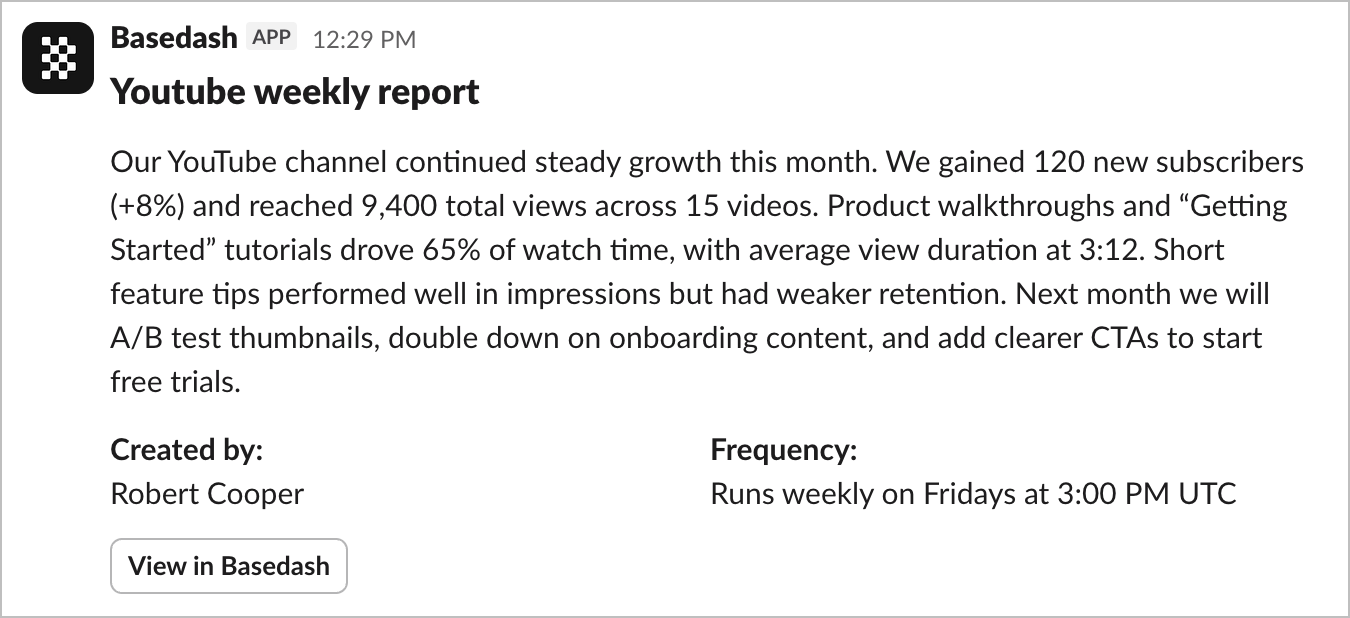 [Automations](/features/automations) can be configured to send notifications to Slack channels when they're generated. This keeps your team informed about scheduled automations without requiring them to check Basedash manually.
To enable Slack notifications for an automation:
1. Open the automation settings panel
2. In the "Slack automations" section, connect Slack if you haven't already
3. Select the channel where you want notifications sent
When the automation runs on its schedule, the results will be posted to the selected channel — including any charts as images — with a link to view the full automation.
To send automations to private channels, you'll need to invite the bot to the
channel first by typing `/invite @Basedash` in that channel.
## Insight notifications
[Insights](/features/insights) can also be delivered to Slack. When Basedash detects a meaningful change in your data — like a spike in signups or a drop in conversion — it posts the insight to your chosen channel, with the supporting chart included as an image.
To enable Slack notifications for insights, open **Settings → Insights → Notifications** in Basedash and select the Slack channel where insights should be posted.
## Multiple data sources
If your organization has multiple data sources connected, Basedash automatically determines the most relevant one based on context. For ongoing thread conversations, it maintains the same data source throughout the thread for consistency.
## A note on privacy and data processing
Anytime a user invokes our Slack app or mentions another user in Slack, we gather that Slack user's profile data and save it in our database so that we can provide rich UIs that make use of the profile information (like avatars, names, etc.). Those Slack profiles saved in our database are associated with a given organization, so if an organization gets deleted, then all the Slack profile data will also get deleted.
See our [Privacy Policy](https://www.basedash.com/privacy-policy) for more details about our general policy used by Basedash.
[Automations](/features/automations) can be configured to send notifications to Slack channels when they're generated. This keeps your team informed about scheduled automations without requiring them to check Basedash manually.
To enable Slack notifications for an automation:
1. Open the automation settings panel
2. In the "Slack automations" section, connect Slack if you haven't already
3. Select the channel where you want notifications sent
When the automation runs on its schedule, the results will be posted to the selected channel — including any charts as images — with a link to view the full automation.
To send automations to private channels, you'll need to invite the bot to the
channel first by typing `/invite @Basedash` in that channel.
## Insight notifications
[Insights](/features/insights) can also be delivered to Slack. When Basedash detects a meaningful change in your data — like a spike in signups or a drop in conversion — it posts the insight to your chosen channel, with the supporting chart included as an image.
To enable Slack notifications for insights, open **Settings → Insights → Notifications** in Basedash and select the Slack channel where insights should be posted.
## Multiple data sources
If your organization has multiple data sources connected, Basedash automatically determines the most relevant one based on context. For ongoing thread conversations, it maintains the same data source throughout the thread for consistency.
## A note on privacy and data processing
Anytime a user invokes our Slack app or mentions another user in Slack, we gather that Slack user's profile data and save it in our database so that we can provide rich UIs that make use of the profile information (like avatars, names, etc.). Those Slack profiles saved in our database are associated with a given organization, so if an organization gets deleted, then all the Slack profile data will also get deleted.
See our [Privacy Policy](https://www.basedash.com/privacy-policy) for more details about our general policy used by Basedash.